The Easiest Way to Sell More Wine Isn’t in the Glass
The most compelling thing on a wine label right now isn’t the typography—it’s the tiny square you almost miss.
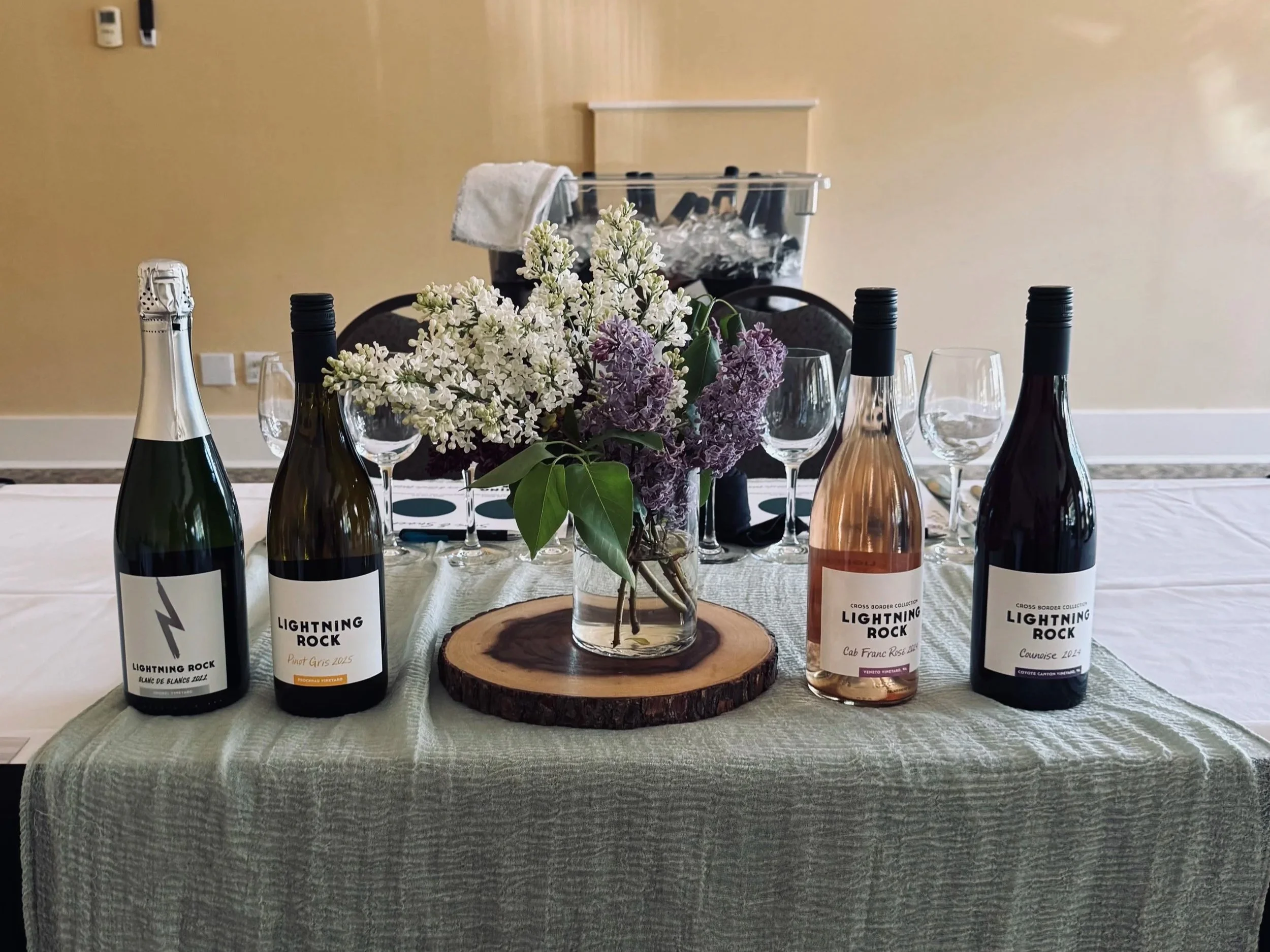
This past weekend, Summerland Waterfront Resort & Spa hosted a beautifully considered “Sips & Bites” evening, pairing Lightning Rock Winery with dishes by in-house chef Ashley. Just over twenty of us were seated at round tables dressed in crisp white linen, small vases of lilac perfuming the air in that subtle, unmistakable way that feels like early summer in the Okanagan.
The wines were exactly the kind you remember, precise, layered, quietly confident. And afterward, as I was selecting a few bottles to take home, I found myself chatting with Ron about the winery itself: how they approach their wines, what they’re building, the intention behind it all. It was in that conversation he casually mentioned something that stayed with me: they’re starting to use QR codes on the back of their bottles to share tasting notes.
A small detail, but one that says a great deal about how they’re thinking—beyond the glass, and into how people actually buy wine. And I, for one, are more than here for it.
The quiet frustration of the wine aisle
There’s a particular kind of decision fatigue that happens in front of a wall of bottles. You pick one up. Turn it over. And…nothing useful.
Or worse, language that feels more like performance than clarity. Notes that sound beautiful but don’t actually tell you what you need to know. If I have the time, I’ll Google something like “best BC bubbly under $40” or “buttery BC Chardonnay,” or even open ChatGPT and go down that rabbit hole.
But most of the time, I’m at Save-On with a child in tow, moving down the wine aisle and trying to make a quick decision somewhere between school pickup and dinner. I don’t have time to be consulting Google or ChatGPT. I don’t want to open three tabs or decode tasting notes like I’m studying for an exam.
And if you’re anything like me, you just want to know: Will I like this?
More often than not, that’s the moment you think to yourself, screw it, and go pick up a bottle of your go-to.
A small shift that changes everything
Now imagine this instead. You turn the bottle over. There’s a small QR code. You scan it—almost without thinking.
And suddenly, the wine speaks plainly:
what it tastes like, in real language
what to pair it with
what kind of moment it belongs to
No friction. No searching. No second-guessing. It’s not about adding more information—it’s about offering the right information, exactly when you need it. And in a category as crowded as BC wine, that’s not a detail. That’s a distinction.
Because the competition is real
BC wineries aren’t competing in a romantic vacuum anymore. They’re competing on shelves that are busy, saturated, and often overwhelming. Where even great wine can be overlooked simply because it isn’t understood quickly enough.
A beautiful label might get someone to pick up the bottle.
But clarity is what gets it into the cart.
A QR code doesn’t replace storytelling, it extends it. It carries the tasting room experience into the aisle, where decisions are faster, attention is shorter, and patience is thin. And like it or not, we live in a society where we’ve been conditioned to immediacy, to have answers, context, and reassurance at our fingertips in seconds.
The part no one talks about: removing the guesswork
There’s an assumption in wine that a bit of mystery is part of the charm. But in reality, mystery can be a barrier. If someone doesn’t understand what they’re buying, they’re less likely to buy it, especially when there are dozens of safer, familiar options within arm’s reach.
A QR code removes that hesitation. It replaces uncertainty with confidence. And confidence, more often than not, is what leads to purchase.
A subtle invitation to stay connected
There’s also something quietly powerful about where that scan can lead. At the end of the page—after the tasting notes, after the story—there’s an opportunity to invite the customer in.
Not aggressively.
Not transactionally.
Just a simple moment:
Join our list for 15% off your next bottle.
It feels less like a marketing tactic and more like a continuation of the experience. A way to turn a single purchase into something ongoing. Because the goal isn’t just to sell a bottle. It’s to be remembered the next time someone stands in that same aisle.
Building an email list allows you to stay connected and turn a customer into a loyal brand advocate.
Why it works
What Lightning Rock is doing isn’t flashy. It’s thoughtful.
It acknowledges something simple but often overlooked: that the way people discover wine and the way they buy it are not the same. And bridging that gap—even in a small way—can make all the difference. A QR code is just a square, but in the right place, at the right moment, it becomes something much more useful.
A guide.
A translator.
A quiet nudge toward yes.
That is not a gimmick. That is helpful information.
The new back label
For years, the back of the bottle has been an afterthought—too small to say much, too static to evolve. But now, it has the potential to be the most dynamic part of the entire experience.
Not louder.
Not busier.
Just smarter.
And in a space where so much is competing for attention, that kind of clarity feels less like innovation—and more like inevitability. And if it saves me from overthinking in the wine aisle, it’s already coming home with me.