The Fashion and Beauty Brief
The Fashion and Beauty Brief — September 21 - 27
Donatella’s next act, Prada’s case for the skirt, Demna finding his Gucci footing and the end—perhaps—of beauty’s barely-there era.
Fashion Month has a way of making a week feel significantly longer than seven days. London wrapped, Milan took over, Vogue World arrived beneath the glass roof of the Galleria Vittorio Emanuele II, and Paris is waiting in the wings.
But beyond the shows, there were a few stories this week that felt bigger than another celebrity front row or limited-edition launch. Donatella Versace announced what comes after Versace. Prada is abandoning trousers. Chanel handed its makeup division to one of fashion’s most respected artists. And beauty, after years of trying very hard to look like we weren’t wearing any, appears ready to look like makeup again.
Donatella Versace is starting again
It turns out leaving the house with your name on the door doesn’t necessarily mean leaving fashion behind.
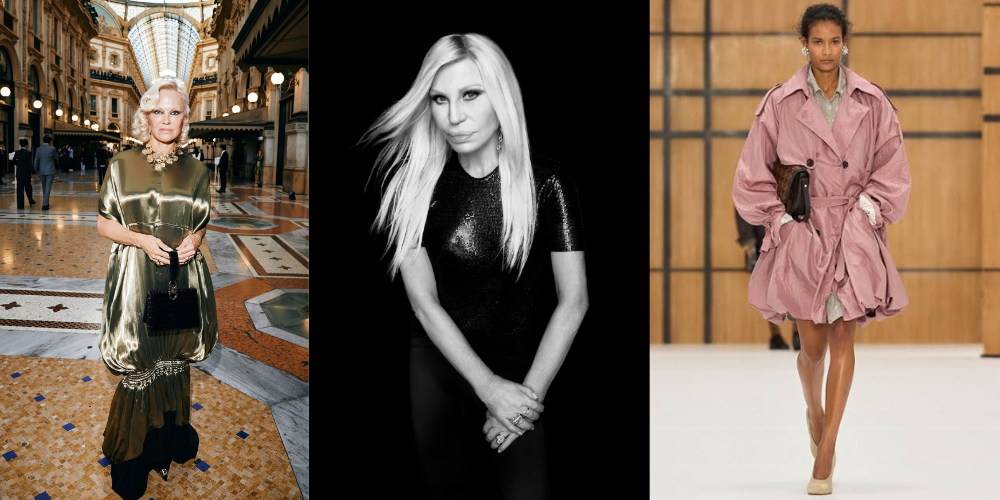
Donatella Versace has entered into a joint venture with Revolve to create a new fashion and beauty business aimed at Millennial and Gen Z consumers. The new venture is expected to launch products in 2027 and comes after Prada acquired Versace and Donatella stepped away from the creative director position she held for almost three decades. She remains Versace’s chief brand ambassador.
The Revolve partnership is interesting for reasons beyond the inevitable curiosity around what Donatella designs without the Versace name attached. Revolve has built its business around digital retail, influencer culture and knowing exactly what its customer wants before her Instagram algorithm does. Donatella, meanwhile, is one of the few designers whose persona is arguably as recognizable as the brand she helped build.
Rather than attempting to recreate another traditional European fashion house, she’s stepping into something distinctly more modern. Whether that becomes a genuine fashion proposition or a very glamorous exercise in celebrity commerce remains to be seen.
Either way, Donatella Versace without Versace might be one of fashion’s more interesting second acts.
Prada would like us to reconsider the skirt
There were no trousers at Prada this week. No dresses either.
For Spring 2027, Miuccia Prada and Raf Simons sent out 63 looks, every one centred around a skirt: pleated, leather, embellished, minimal, practical and occasionally rather strange.
On paper, dedicating an entire collection to the skirt sounds dangerously close to a styling exercise. In practice, it became a study in just how differently one garment can behave depending on what surrounds it.
A skirt appeared with a lace bra in one look and a sensible knit in another. Some felt almost prim; others looked deliberately undone. It was less the skirt is back—did it ever actually leave?—and more a rejection of the idea that getting dressed needs to follow one prescribed silhouette.
Which feels timely.
For several seasons, fashion has been dominated by recognizable formulas: oversized blazer, straight-leg trouser, loafer; minimalist knit, perfect denim, expensive-looking coat. Prada’s proposition felt messier and considerably more personal.
Perhaps the most interesting trend coming out of Fashion Month isn’t another item we need to buy. It’s the slow dismantling of the idea that everyone needs to be dressed according to the same algorithm.
Demna is beginning to show us what his Gucci actually looks like
A year into Demna’s tenure at Gucci, the question has shifted from What will he do with Gucci? to something slightly more useful: What does Gucci mean to him?
For Spring 2027, the designer transformed Milan’s convention centre into a replica Gucci boutique—a preview of the retail world he is building around the house—and presented a collection pulling from several different versions of Gucci at once. There were equestrian references, bourgeois trenches, slinky evening dresses, prep-school pieces gone slightly bad and echoes of the Tom Ford years.
Demna himself has acknowledged that it took time to understand a house with this many identities.
That tension may actually be the most interesting thing about his Gucci.
For years, luxury fashion moved toward discretion: small logos, muted palettes and clothes designed to communicate wealth without appearing to try. Demna is moving in the opposite direction. His Gucci is sensual, occasionally excessive and very aware that fashion can be a performance.
Quiet luxury isn’t disappearing tomorrow. But it no longer feels like the only acceptable way to look expensive.
At Fendi, Maria Grazia Chiuri loosened up
Maria Grazia Chiuri’s second ready-to-wear collection for Fendi took its cues from Italian singer and ’70s icon Raffaella Carrà—a woman known for sequins, exposed midriffs, platinum hair and a general lack of interest in behaving demurely.
The resulting collection included diaphanous dresses, visible bras and a freer version of femininity than the designer became known for during her years at Dior. Chiuri told The Guardian that since returning to Rome, she has found herself wearing less of a uniform and feeling younger again. You could see it in the clothes.
There has been an interesting looseness running through Milan this season: less concern with perfect good taste, more interest in personality. Fendi’s version came with lingerie, colour and Italian pop glamour.
Moschino has entered its post-Appiolaza era
Moschino also began again this week.
Former Sunnei founders Simone Rizzo and Loris Messina presented their first collection as co-creative directors following Adrian Appiolaza’s departure earlier this year.
For their debut, they staged the show on the roof of a Milan parking garage while hundreds of people—talking on phones, walking dogs and generally behaving like people rather than runway props—moved in the opposite direction of the models.
The point, Rizzo explained, was that the clothes belong on the street and to real people.
For a house founded by a designer who famously enjoyed poking holes in fashion’s self-importance, handing Moschino to two designers known as much for their clever presentations as their clothes makes a certain amount of sense.
It’s still too early to decide exactly what their Moschino will become. But the instinct—to put fashion back into the mess of actual life rather than hold it at arm’s length—feels promising.
London decided wearability wasn’t a dirty word
Before Milan began, London Fashion Week ended with something fashion has occasionally treated with suspicion: clothes people might genuinely want to wear.
Christopher Kane debuted at Mulberry, McQueen returned to the London schedule, Burberry closed the week, and designers across the calendar leaned noticeably further into tailoring, dresses, lingerie references and pieces with an obvious life beyond the runway. Vogue described the season as one in which commercial viability and creativity were beginning to coexist rather than compete. It’s an important distinction.
Wearable does not have to mean boring, in the same way that experimental does not automatically mean good. Some of the strongest fashion right now seems to sit somewhere between the two: interesting enough to make you look twice, realistic enough to imagine in an actual wardrobe.
Fashion is getting more extravagant at exactly the moment luxury is under pressure
Behind Milan’s runways sits a less glamorous story.
Luxury brands are fighting harder for consumers whose spending habits have changed. Reuters reported this week that major fashion houses can spend as much as €10 million on a single runway production, even as luxury groups deal with softer demand and shoppers increasingly direct discretionary spending toward travel, wellness and experiences instead of another handbag. Which creates an interesting contradiction.
Fashion has rarely been better at producing spectacle. Shows are increasingly elaborate, destinations more ambitious and front rows more famous. At the same time, the industry has to give consumers a reason to believe that the product at the centre of all this theatre is still worth the price attached to it.
Vogue World Milano was perhaps the most extravagant example this week, taking over the Galleria Vittorio Emanuele II with a five-act celebration of Italian craftsmanship, fashion, manufacturing and innovation. Beautiful? Absolutely.
But underneath the brocade and celebrity cameos sits one of fashion’s bigger questions: in an era when we have more clothes than ever, what makes someone want something new?
Chanel has a new Creative Makeup Director
Over in beauty, Chanel made one of the week’s most significant appointments.
Makeup artist Lucia Pieroni has been named Chanel’s new Creative Makeup Director. She will work alongside the house’s Makeup Creation Studio under Simona Cattaneo, president of fragrance and beauty. Pieroni previously spent more than a decade as creative director of makeup at Clé de Peau Beauté and has worked extensively across runway, editorial and campaign beauty.
The appointment feels particularly interesting alongside Matthieu Blazy’s reshaping of Chanel fashion.
A beauty identity is often as important to a house as its clothes—think Chanel red lipstick, the interlocking Cs or a bottle of No. 5—and Pieroni now has the opportunity to help define what the next iteration looks like.
The question is no longer simply what the new Chanel woman wears. It’s what her face looks like, too.
Is beauty finally ready to look like makeup again?
For the better part of a decade, many of beauty’s dominant trends have involved applying an impressive number of products in pursuit of looking as though you applied almost none. Glazed skin. Fluffy brows. Lip oil. The endlessly referenced clean girl. Milan offered something different.
At Vogue World, Dame Pat McGrath looked to Renaissance portraiture for the makeup, building layered blush and softly sculpted skin inspired by painters including Raphael and Botticelli. Other looks throughout the production incorporated glitter and more overtly decorative makeup.
Then Pamela Anderson—whose largely makeup-free appearances became a beauty story of their own beginning in 2023—arrived wearing black liner, smoky eyes, lashes and glossy pink lips. One evening does not constitute the death of clean beauty.
But paired with the return of visible blush, brown and black liner, richer lip colours and more expressive runway makeup, there is a noticeable appetite for looking done again. Not overdone. Not necessarily full glam. Just no longer pretending the makeup bag doesn’t exist.
The great eye-patch coincidence
And then there was arguably the most beauty-industry story of the week. Fenty Skin, Glow Recipe, Huda Beauty and Vitamasques all teased hydrogel eye patches using strikingly similar grinder-style packaging within days of one another.
Rather than fishing around a jar with a tiny spatula, users twist the package to dispense an individual eye mask.
Fenty’s product was initially pitched as a first-of-its-kind innovation, but the near-simultaneous launches quickly raised a much more interesting question: when brands have access to the same suppliers, manufacturers and packaging systems, who actually gets to claim ownership of an idea?
Beauty’s development cycle has become so fast that multiple brands can apparently arrive at almost the exact same innovation at almost the exact same moment. Consider it the skincare equivalent of turning up to a party in the same dress.
Also on the beauty radar
Cécred is moving beyond the hair on your head. Beyoncé’s haircare brand launched its Restoring Lash & Brow Builder Trio this week, extending the brand’s treatment philosophy into lashes and brows.
Estée Lauder has launched Glimmer. The new fragrance is built around the idea of “glimmers”—small everyday moments associated with happiness, peace or comfort. It’s another example of fragrance marketing leaning increasingly into mood and emotional experience rather than the traditional wear this and become impossibly seductive formula.
Hair longevity is becoming a category of its own. Arey, a brand focused on greying, density and aging hair, secured Series A investment led by Unilever Ventures. Skin longevity has already become one of beauty’s favourite phrases; expect scalp and hair aging to continue following close behind.
And finally, the FDA updated its regulations around non-animal testing methods for drugs and biologics, explicitly allowing validated alternatives including human-cell models, organs-on-chips and computer modelling where appropriate. This is not a new cosmetics regulation or an outright ban on animal testing, but the broader scientific shift toward validated non-animal testing methods is relevant to an industry that relies heavily on advances in the same research technologies.
What I’m watching next
Fashion Month moves to Paris next, but the more interesting thread may already be emerging.
After several years of restraint, polish and clothes designed to signal good taste as quietly as possible, fashion seems interested in personality again. Prada dedicated an entire show to skirts. Fendi looked to a sequined Italian pop star. Gucci is getting louder. Moschino put its runway in the middle of ordinary life.
Beauty appears to be moving in a similar direction: visible liner, painterly blush, richer colour and products that aren’t afraid to announce themselves. None of this means minimalism is over. Fashion rarely changes that neatly.
But perhaps the era of everybody trying to look like the same very tasteful woman—with the same perfect blazer, slicked-back bun and imperceptible makeup—is beginning to fade. Not because there’s anything wrong with that look, but because not everyone needs to look like that. Maybe fashion is finally making room for more individuality again. After all, style is personal.